
Inspection and maintenance of pavements are essential activities to ensure the good performance, safety, and durability of road infrastructures throughout their life cycle. A properly inspected and maintained pavement makes it possible to reduce overall costs, minimize large-scale interventions, and ensure adequate levels of comfort and safety for users.
Inspection and maintenance accompany the pavement throughout its service life, providing the necessary information to support technical and strategic decisions [1].
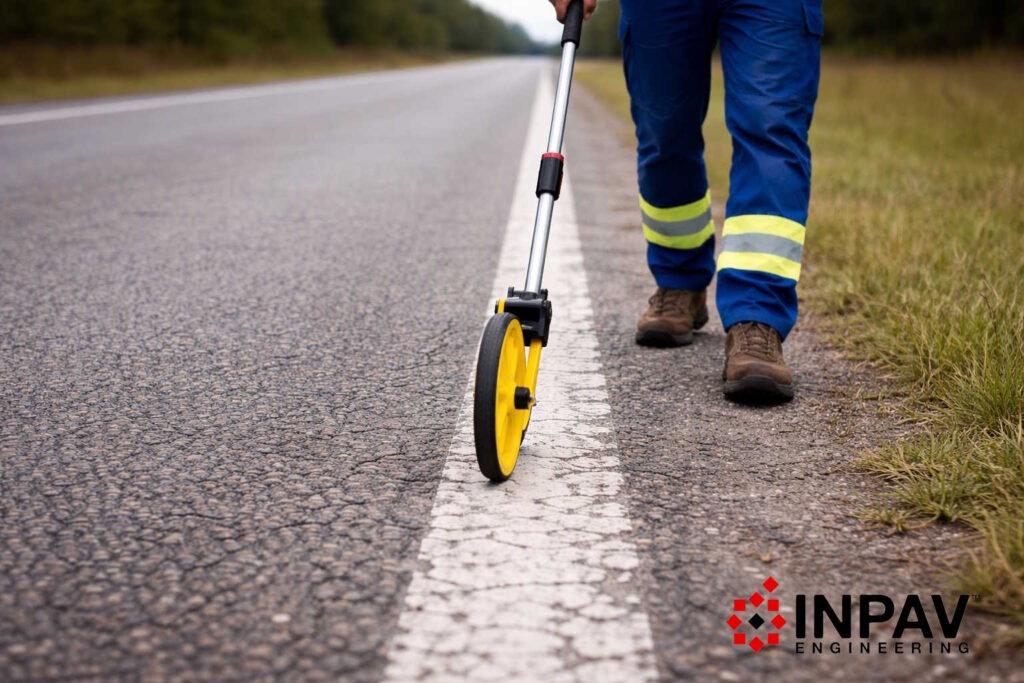
The importance of inspecting the condition of preservation
Pavement inspection aims to identify, locate, and characterize existing distresses, assess their degree of severity, and understand the evolution of the infrastructure’s condition. This information is essential to:
- Diagnose structural and functional problems
- Define intervention priorities
- Select appropriate maintenance solutions
- Plan investments in a rational and sustainable manner
Traditional inspection methods, based on manual records and poorly integrated processes, are often time-consuming, costly, and prone to errors, hindering the efficient management of road networks.
Maintenance as a management strategy
Pavement maintenance should not be seen as a punctual response to visible deterioration, but rather as part of a road asset management strategy. Timely and well-planned interventions make it possible to:
- Significantly extend the service life of the pavement
- Avoid more complex and costly rehabilitation solutions
- Reduce environmental impacts and traffic disruptions
To this end, it is essential to have reliable, consistent, and up-to-date data, obtained through systematic and properly executed inspections.
The role of Inpav Audit in pavement inspection and maintenance
Inpav Audit is an integrated digital system designed to support visual inspection campaigns, condition characterization, and maintenance management of road pavements [1].
Through Inpav Audit it is possible to:
- Carry out visual inspections quickly and accurately
- Record georeferenced distresses, with classification by type and severity
- Automatically associate photographic records and technical notes
- Drastically reduce manual work and data processing time
- Automatically generate technical reports
Its high portability allows use on foot or in a vehicle, being especially effective at complex intersections, urban areas, and high-traffic zones, where traditional methods or heavy inspection systems are poorly suited.
Decision support and maintenance management
In addition to inspection, Inpav Audit allows the collected information to be integrated into maintenance management databases, facilitating:
- Monitoring the evolution of deterioration over time
- Defining intervention priorities
- Planning preventive and corrective maintenance actions
- Coordination between inspection, diagnosis, and intervention
This integrated approach transforms field data into useful information for decision-making, supporting managing authorities, concessionaires, and engineering firms.
An integrated approach to the pavement life cycle
Pavement inspection and maintenance complement the work developed during the design and dimensioning phase. Together with solutions such as Inpav Design, Inpav Audit contributes to an integrated approach to the pavement life cycle, from conception to in-service management.
The result is a more efficient, sustainable, and technically sound way to design, assess, and maintain road infrastructures.
[1] N. Verdelho Trindade, “Development of a computerized, low-cost, portable system for visual inspection, characterization and maintenance management of highway pavements,” in Proc. 16th Int. Road Federation (IRF) World Meeting, paper 458, Int. Road Federation, Lisbon, Portugal, 2010. [Online]. Available: https://www.researchgate.net/publication/357254944_Development_of_a_Computerized_Low-Cost_Portable_System_for_Visual_Inspection_Characterization_and_Maintenance_Management_of_Highway_Pavements